


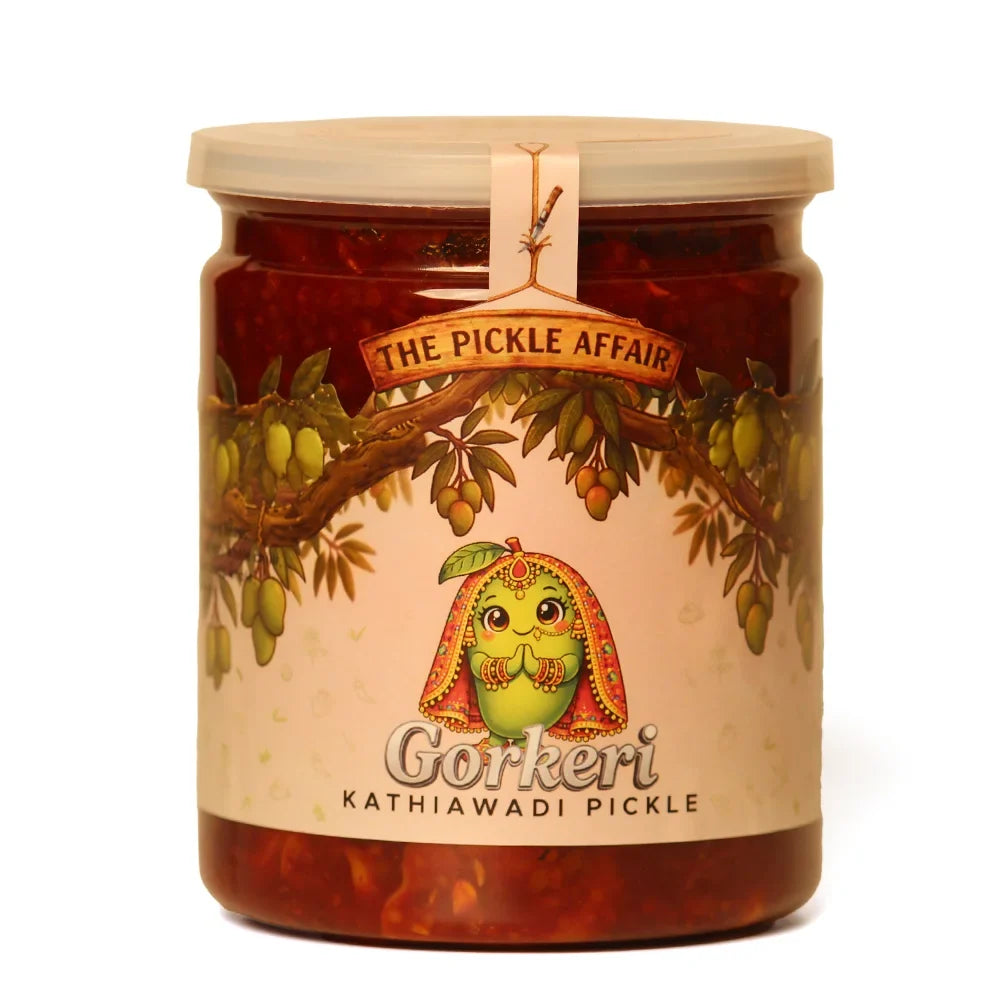
Why Gujarati kitchens use jaggery in mango pickle, how it changes flavour and colour, and how it differs from sugar.
In this guide
- Quick answer
- What jaggery brings
- Jaggery vs sugar in pickle
- Living with a jaggery pickle
- How jaggery goes into a pickle
- Not all jaggery is the same
- How jaggery works with pickle spices
- Gor Keri on the thali
- Why colour and thickness vary
- Jaggery and sugar side by side
- Making a jaggery pickle last
- Who tends to enjoy jaggery pickles
- Jaggery pickles in Gujarati tradition
- Jars to consider
- FAQs
Quick answer
Jaggery (gor) adds a deep, caramel-like sweetness and a dark colour to mango pickle, and like sugar it helps preserve it. Gor Keri is the classic example: raw mango pieces in a thick jaggery masala.
What jaggery brings
- A rounder, less sharp sweetness than white sugar.
- Caramel and mineral notes.
- A deep brown-red colour.
- A thick syrup that coats the mango pieces.
Jaggery vs sugar in pickle
Sugar gives a clean sweetness that lets mango sourness stand out — used in Chhundo and many Meethi Keri recipes. Jaggery gives a heavier, warmer sweetness that blends with mustard and chilli.
We do not claim jaggery makes pickle healthy; it is still a sweetener. The choice is about taste.
Living with a jaggery pickle
Jaggery syrup can thicken or crystallise in cool weather. That is natural — stir with a dry spoon.
Sweet syrups attract ants, so wipe the rim and close the lid firmly.
How jaggery goes into a pickle
Recipes differ, but the jaggery is usually either grated finely and mixed into the salted, drained mango with the masala, or melted gently into a syrup first. As it dissolves, it pulls moisture from the mango and forms a thick, dark coating around each piece.
Many traditional Gor Keri recipes then let the jar rest, sometimes in the sun, so the jaggery fully dissolves and the flavours blend. The result is a pickle where sweetness, sourness, and spice arrive together rather than one after another.
Because jaggery holds more moisture than sugar, cooks pay close attention to how dry the mango is before it goes in. Well-drained mango and fully dissolved jaggery give a thick, glossy pickle; wet mango can make the syrup thin and less stable.
Not all jaggery is the same
Most jaggery used in Gujarati pickles is made from sugarcane. Its colour ranges from pale gold to deep brown depending on how the juice is boiled and where the cane grows, and the flavour ranges from mild honey to strong molasses.
Darker jaggery gives a darker, more intense pickle; lighter jaggery gives a brighter, milder one. This is one reason Gor Keri from different homes — or even different batches — can look and taste slightly different.
Jaggery also absorbs moisture from the air, which is why good cooks store it dry and use it quickly once opened. The same care applies to a jaggery pickle: dryness keeps its syrup thick and its flavour clean for longer.
How jaggery works with pickle spices
Jaggery is especially good at rounding off bitter and pungent notes. Fenugreek, which can taste harsh on its own, becomes pleasantly bittersweet next to gor. Split mustard loses some of its sharpness, and red chilli feels warmer rather than sharper.
That is why jaggery pickles often feel less 'sweet' than sugar pickles with the same amount of sweetener: the jaggery blends into the spice rather than sitting on top of it. It suits people who find Chhundo too sweet but spicy keri achar too sharp.
Gor Keri on the thali
On a Gujarati thali, Gor Keri usually plays the sweet-sour role opposite a spicy pickle. It is particularly useful beside spicy shaak, fried farsan, or kadhi-khichdi, where a little sweetness balances the meal.
Outside the thali, it pairs well with rotli and ghee, thepla, and bajra rotla, where it can even take the place of the plain lump of jaggery that is traditionally served alongside.
At festive meals, Gor Keri is often placed next to farsan such as dhokla, khaman, or fried snacks, where its sweet-sour taste cuts through oil in the same way a chutney would.
Why colour and thickness vary
- Jaggery colour and moisture differ from one batch of cane to the next.
- Warm weather keeps the syrup loose; cold weather thickens it.
- Over weeks, the mango releases more juice and the syrup darkens.
- Crystals may form in cool weather; stirring with a dry spoon helps.
- None of these changes on its own means the pickle has spoiled.
Jaggery and sugar side by side
- Colour — jaggery gives brown to deep red-brown; sugar keeps the pickle golden or amber.
- Flavour — jaggery tastes of caramel and molasses; sugar tastes clean and sweet.
- Texture — jaggery syrup is usually thicker and more opaque; sugar syrup is glossier.
- Pairing — jaggery suits rustic plates such as rotla and khichdi; sugar suits tea-time snacks such as khakhra and thepla.
- Examples — Gor Keri uses jaggery; Chhundo typically uses sugar.
Making a jaggery pickle last
Sweet syrups attract ants and pick up moisture from the air more readily than oil does. Close the lid firmly after every use and wipe away any syrup on the rim or threads of the jar.
If you see the syrup crystallising in cold weather, do not add water to loosen it. Stir with a dry spoon, or let the jar sit somewhere warmer for a while. Adding water is one of the quickest ways to spoil a sweet pickle.
Who tends to enjoy jaggery pickles
Jaggery pickles often win over people who find spicy achar too sharp but sugar-based pickles too sweet. They are also popular with elders who grew up with gor on the plate at every meal, and with children who are just starting on pickle.
If you are unsure, try Gor Keri beside a spicy mango pickle for a week and notice which spoon you reach for with which dish.
Jaggery pickles in Gujarati tradition
Jaggery has a special place in Gujarati food. A small piece of gor is often served with the thali, and many everyday dishes — dal, kadhi, shaak — use a little jaggery to balance sour and spicy flavours. It is not surprising that the same instinct shaped pickles.
Gor Keri follows this logic. Rather than choosing between sweet and spicy, it uses jaggery to hold both together, which is why it feels at home on a Gujarati plate alongside dishes that are themselves gently sweet and sour.
For people who grew up outside Gujarat, Gor Keri can be a good introduction to that style of cooking. Taste it with a plain rotli first, then with dal-bhaat, and notice how the jaggery softens the chilli rather than hiding it.
What to check when a glass jar arrives
Pickles travel in glass because glass does not react with oil, salt, or acid. When your parcel arrives, check the seal before anything else: the lid should be tight and there should be no oil seepage on the outer packing. A little oil on the rim is normal after transit and can be wiped away.
If a jar arrives cracked or the seal is broken, do not taste it — photograph it and contact us through the Contact page so it can be replaced. Once opened, move the jar straight to a cool cupboard rather than leaving it on the counter.
Shop related collections
These collection hubs match this guide’s intent — use them to compare jars before you buy:
Jars to consider from this guide

Gor Keri | Jaggery Mango Achar
Handmade Kathiawadi pickle — ships across India.
View Gor Keri | Jaggery Mango Achar →Frequently asked questions
Why is jaggery used in pickle?
For a deep, caramel-like sweetness and colour; it also helps preserve the pickle.
Is jaggery pickle healthier than sugar pickle?
We do not make health claims; both are sweeteners. Choose by taste.
Why does my jaggery pickle look crystallised?
Jaggery can crystallise in cool weather; it is natural.
Does jaggery pickle taste very sweet?
It is sweet, but jaggery blends with the spices, so many people find it less sugary than sugar-based pickles.
Why is Gor Keri darker than Chhundo?
Jaggery is naturally brown, while Chhundo uses white sugar, so Gor Keri is darker.
Can I use Gor Keri instead of jaggery on the thali?
Yes. Many people serve Gor Keri in place of a plain piece of gor, getting sweetness and sourness in one spoon.
Does jaggery pickle need the fridge?
Usually not. Keep it in a cool, dark cupboard with a tight lid; the fridge will thicken the syrup.
Is Gor Keri spicy?
It has gentle spice from chilli and mustard, but the jaggery softens it, so most people find it mild.
Does The Pickle Affair use synthetic colours?
No. Colour comes from the spices, turmeric, chilli, and mango themselves.
Who makes The Pickle Affair pickles?
The Pickle Affair is a brand of Arham Foods, packed in Maharashtra under FSSAI licence 21521053000490.
Conclusion
Jaggery gives Gor Keri its depth. If you like gur in your chai, you will likely prefer it to sugar-based sweet pickles.


Leave a comment
Your email address will not be published. Required fields are marked *