


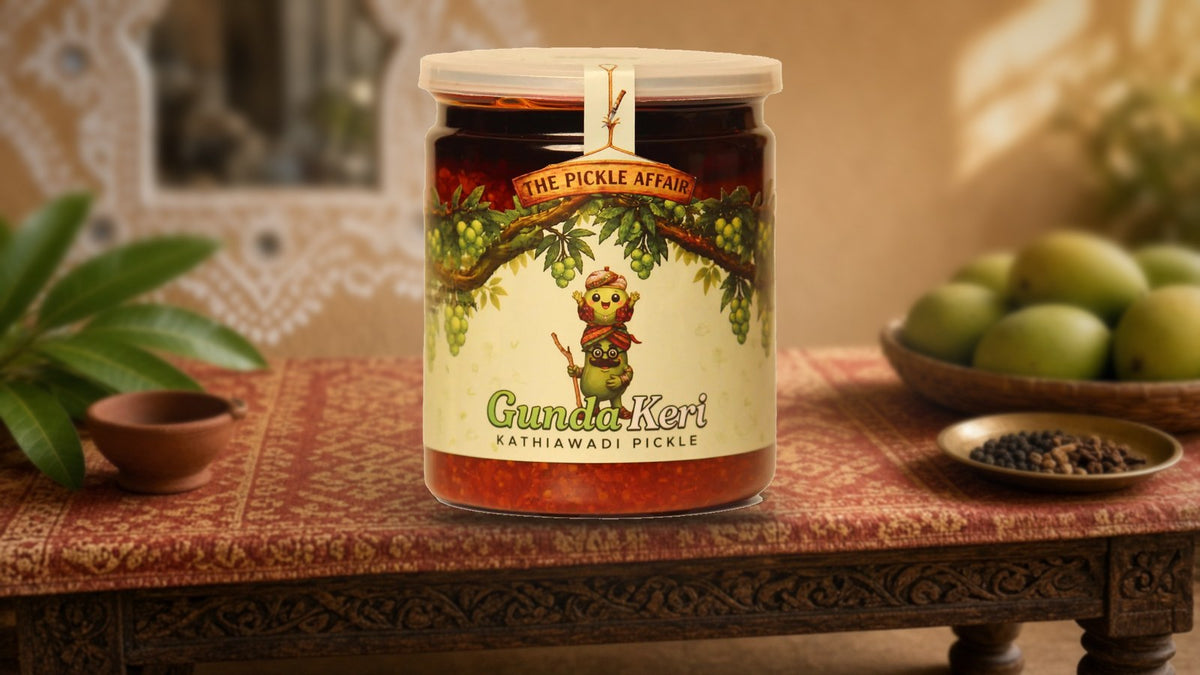
Lasoda, gunda, or Indian cherry — the sticky Cordia fruit behind Gunda Keri pickle, explained.
In this guide
- Quick answer
- The fruit
- Why it is pickled
- Eating Gunda Keri
- Names for the same fruit
- Preparing gunda for pickle
- Gunda beyond pickle
- How to recognise good Gunda Keri
- Why Gunda Keri is a specialty jar
- Eating Gunda Keri for the first time
- Storing Gunda Keri
- Gunda through the seasons
- Jars to consider
- FAQs
Quick answer
Lasoda (called gunda in Gujarati) is the small fruit of the Cordia tree, known in English as Indian cherry or glue berry. Its flesh is naturally sticky. In pickle it softens and becomes chewy, which is the signature of Gunda Keri.
The fruit
Gunda grows on Cordia trees across Gujarat, Rajasthan, and dry parts of North India. The fruit is small and round, green when unripe, with a sticky, mucilaginous flesh around a single seed — which is why it is also called 'glue berry'.
It is mostly used unripe, in pickles and in some dry vegetable preparations. Its season is short, usually early summer, around the same time as raw mango.
Why it is pickled
- Its short season makes pickling the traditional way to enjoy it year-round.
- The sticky flesh absorbs mustard and chilli masala deeply.
- It softens in oil into a chewy texture no other pickle has.
- It pairs naturally with raw mango, which ripens at the same time.
Eating Gunda Keri
Depending on the recipe, gunda is pickled either slit and deseeded or whole; if you find a seed, simply set it aside. Expect a soft, sticky bite that carries the masala, alongside firmer mango pieces.
It suits bold plates such as bajra rotla, khichdi, and curd rice. First-time buyers should try the 250 g jar.
Names for the same fruit
The fruit goes by many names. Gujarati homes call it gunda; in Hindi and in Rajasthan it is lasoda or lasora. In English it is sometimes called Indian cherry, glue berry, or Assyrian plum, and botanically it belongs to the Cordia genus — Cordia dichotoma and the closely related Cordia myxa are the species most often mentioned.
When you see 'lasode ka achar' on a North Indian menu and 'Gunda Keri' in a Gujarati kitchen, they refer to the same family of pickle, although the masala and the proportion of mango differ from home to home.
Because the same fruit has so many names, online searches can be confusing. If you are looking for the pickle, 'Gunda Keri', 'gunda pickle', and 'lasode ka achar' will usually lead you to the same kind of jar.
Preparing gunda for pickle
Gunda is picked while still green and firm. It is washed and dried thoroughly, because any surface water will cause trouble once it goes into oil. The small cap at the top is removed.
Many cooks then slit each berry and take out the seed. This is the slow part: the flesh is so sticky that it clings to fingers and knives, so people rub a little salt or oil on their hands, or press the seed out against a hard surface. The emptied gunda is filled with masala, which is why each piece carries so much flavour.
Other recipes skip the deseeding and pickle the berries whole, which is quicker but gives a different bite. Either way, the gunda is combined with raw mango pieces, more masala, and oil, then left to mature.
Gunda beyond pickle
Although pickle is the best-known use, unripe lasoda is also cooked as a vegetable in parts of Rajasthan and Gujarat, usually as a dry sabzi with spices. Its sticky texture softens with cooking in much the same way as it does in oil.
Because the fruiting season is short, fresh gunda can be hard to find in city markets outside early summer. Pickling remains the main way most families enjoy it through the rest of the year.
How to recognise good Gunda Keri
- Gunda pieces that are soft and chewy but still hold their shape.
- Masala clinging to the gunda, not just sitting in the oil.
- A mix of gunda and firm mango pieces, rather than mango alone.
- Pieces covered by oil, with no dry patches on top.
- A clean, spicy, mustard-forward aroma with no musty or alcoholic smell.
Why Gunda Keri is a specialty jar
Three things keep Gunda Keri rarer than plain mango pickle: the short season in which gunda and raw mango overlap, the slow hand-work of preparing sticky berries, and the fact that its taste is familiar mainly to people from Gujarat and Rajasthan.
For many buyers outside those regions, the first jar is a surprise — the chewy texture is unlike any other Indian pickle. For those who grew up with it, it is often the pickle they miss most after moving away.
If you are curious but unsure, the 250 g jar is the easiest way to try it. Serve a few pieces with bajra rotla or khichdi first, since those are the plates where Gunda Keri is most at home, and decide from there whether it deserves a permanent place on your shelf.
Eating Gunda Keri for the first time
Take one gunda piece and one mango piece with a bite of rotli or rotla. The mango gives the familiar sour crunch; the gunda gives a soft, slightly sticky chew that holds the masala. Some people love it immediately, while others need a few tries to get used to the texture.
Start with a small amount. Gunda absorbs a lot of masala, so a single piece can carry more spice than you expect.
Storing Gunda Keri
Gunda Keri follows the same rules as other oil-cured pickles: a completely dry spoon, pieces kept under the oil, a tightly closed lid, and a cool, dark cupboard away from the stove and sink.
Because the gunda keeps softening, the texture will become chewier over the life of the jar. That is expected. Discard the jar only if you see mould, notice fizzing, or smell anything musty or alcoholic.
Gunda through the seasons
Gunda trees fruit in early summer, and in Gujarat that is also the peak season for raw mango. For generations, this overlap set the pickle-making calendar: families bought gunda and mango in the same weeks, and the whole household helped clean, deseed, and cut before the masala went in.
Once the short gunda season ends, fresh berries become hard to find, and the only way to eat them until the next summer is from the pickle jar. That is why Gunda Keri is often made in larger batches than other specialty pickles and shared among relatives.
Today, buying a ready jar saves the hours of sticky hand-work, but the pickle still follows the same seasonal rhythm. Its supply depends on the gunda harvest, which is one reason specialty gunda pickles are harder to find than everyday mango pickle.
What to check when a glass jar arrives
Pickles travel in glass because glass does not react with oil, salt, or acid. When your parcel arrives, check the seal before anything else: the lid should be tight and there should be no oil seepage on the outer packing. A little oil on the rim is normal after transit and can be wiped away.
If a jar arrives cracked or the seal is broken, do not taste it — photograph it and contact us through the Contact page so it can be replaced. Once opened, move the jar straight to a cool cupboard rather than leaving it on the counter.
Shop related collections
These collection hubs match this guide’s intent — use them to compare jars before you buy:
Jars to consider from this guide

Gunda Keri | Lasode ka Achar
Handmade Kathiawadi pickle — ships across India.
View Gunda Keri | Lasode ka Achar →Frequently asked questions
What is lasoda in English?
Lasoda is the fruit of the Cordia tree, often called Indian cherry or glue berry.
Is gunda the same as lasoda?
Yes. Gunda is the Gujarati name and lasoda is the Hindi name for the same fruit.
Why is gunda sticky?
Its flesh is naturally mucilaginous; in pickle it becomes soft and chewy.
Is lasoda the same as Cordia?
Yes. Lasoda or gunda is the fruit of Cordia trees, most commonly Cordia dichotoma or Cordia myxa.
Can lasoda be cooked as a vegetable?
Yes. In parts of Rajasthan and Gujarat, unripe lasoda is also cooked as a dry sabzi.
What does gunda taste like?
On its own it is mild and slightly astringent. In pickle it takes on the flavour of the mustard and chilli masala and becomes soft and chewy.
Is Gunda Keri the same as lasode ka achar?
They are closely related. Both are pickles of lasoda or gunda; Gunda Keri adds raw mango, and masala varies by region and family.
Does The Pickle Affair use synthetic colours?
No. Colour comes from the spices, turmeric, chilli, and mango themselves.
Who makes The Pickle Affair pickles?
The Pickle Affair is a brand of Arham Foods, packed in Maharashtra under FSSAI licence 21521053000490.
Conclusion
Lasoda is what makes Gunda Keri unique. If you have never tried it, start with a small jar and pair it with a bold meal.


Leave a comment
Your email address will not be published. Required fields are marked *