


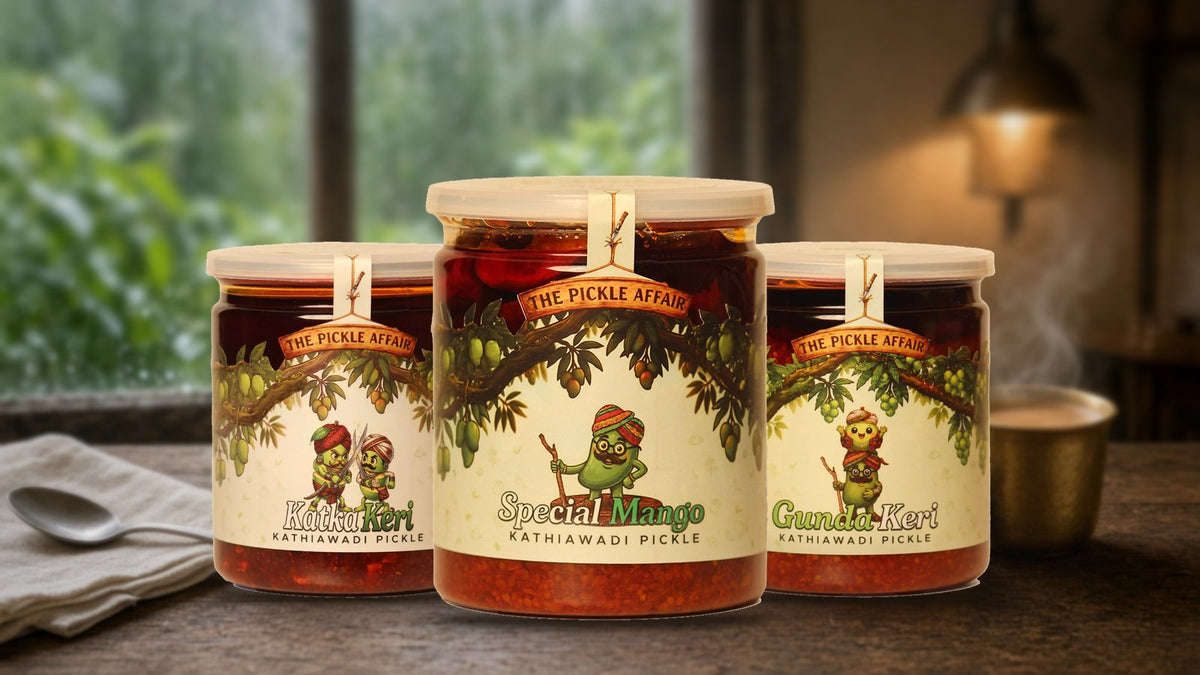
The oil in achar is not excess; it protects the pickle. Why it is there, how to serve with less of it, and what to do with leftover oil.
In this guide
- Quick answer
- The short answer: oil is a seal
- What the oil does
- Why traditional recipes use so much
- Why the oil level changes over time
- Oil as the flavour carrier
- Does more oil mean a better pickle?
- How to serve with less oil
- Do you have to eat the oil?
- If the oil drops below the pieces
- Using leftover pickle oil
- Signs the oil has gone off
- Jars to consider
- FAQs
Quick answer
The oil layer in traditional pickle seals the mango and masala from air and moisture, which helps it keep for a long time without synthetic preservatives, and it carries the flavour of the spices. You do not need to eat the oil: lift the pieces out and leave most of it in the jar to protect the rest.
The short answer: oil is a seal
If you have ever opened a jar of Indian pickle and wondered why pickle has so much oil, you are not alone. It is one of the most common questions people ask about achar, and the answer is simple: the oil is doing a job.
Spoilage needs air and moisture. Salt has already pulled most of the water out of the mango, and the oil covers what is left so that air and damp cannot reach it. That is why pickle has so much oil: the layer has to be deep enough to keep every piece covered for as long as the jar lasts.
What the oil does
- Forms a barrier over the pieces so air and moisture cannot reach them.
- Carries the flavour of mustard, fenugreek, chilli, and hing through the jar.
- Keeps the masala moist so it clings to the pieces instead of drying out.
- Slows the oxidation that dulls colour and flattens taste.
- Shows you, at a glance, whether the pieces are still protected.
Why traditional recipes use so much
When a pickle is made, oil is poured in until the pieces are well covered, and then the jar is left to rest. Over the next few days the masala and the mango soak up some of that oil, and the level drops. Cooks check again and top up so the pieces stay under.
There is also the matter of use. Every time a spoon goes in and pieces come out, the level shifts and some pieces rise. A generous layer means the pickle stays covered right to the bottom of the jar, not just in the first week.
So if you are asking why pickle has so much oil, the answer is that the oil you see is not a sign of carelessness. In a traditional Kathiawadi pickle such as our Homemade Mango Pickle, it is part of the recipe's design.
Why the oil level changes over time
It is normal to see the oil level move during the life of a jar. In the first days after making, the masala absorbs oil and the level falls. Later, as the mango releases a little juice and the masala settles to the bottom, oil can rise to the top and look like more than before.
Temperature plays a part too. In cold weather or in the fridge, oil thickens and can look cloudy or solid, then clears again at room temperature. None of these changes on its own means anything is wrong.
Oil as the flavour carrier
Many of the aromas in achar masala dissolve in fat rather than water. Split mustard, fenugreek, chilli, and hing release their flavour into the oil, and the oil then coats every piece of mango. That is why the oil itself tastes so strongly of the pickle.
It is also why a pickle tastes rounder after it has rested. In the first days the spices are still sharp and separate; once the oil has carried them through the jar, sourness, heat, and bitterness settle into one flavour.
Does more oil mean a better pickle?
Not necessarily. What matters is that the pieces stay covered, not that the jar is filled to the brim. Too little oil leaves pieces exposed and more likely to spoil; far more than needed simply sits on top.
Not every pickle relies on oil, either. Sweet Gujarati pickles such as Chhundo, Meethi Keri, and Gor Keri are preserved mainly by sugar or jaggery syrup, so they look and feel very different from oily keri achar. If you prefer less oil on the plate, a sweet pickle may suit you better.
How to serve with less oil
- Use a dry slotted spoon, or tilt a regular spoon so the oil drains back as you lift.
- Press each piece gently against the inside of the jar before taking it out.
- Serve on a small katori or the edge of the plate rather than straight onto rice.
- Take only what you will eat at that meal.
- Press the remaining pieces back under the oil and close the lid firmly.
Do you have to eat the oil?
No. The oil's main job is in the jar, protecting the pieces that are still there. Most people take the pieces with only the oil that clings to them and leave the rest behind.
Pickle is a condiment, meant to be eaten in small amounts beside a meal. Enjoy it in small portions as part of a balanced diet, and let the oil in the jar keep doing its work.
If the oil drops below the pieces
Sometimes, towards the end of a jar or after heavy use, the top pieces poke above the oil. Press them down with a dry spoon first; often the masala underneath releases enough oil to cover them again.
If pieces still sit above the oil, eat those first rather than leaving them exposed. Some homes top up their own pickle with the same kind of oil, heated and cooled completely, but for a bought jar, eating the exposed pieces first and keeping the lid tight is the simplest approach. Our Katka Keri and Gunda Keri chunks are easy to press back under.
Using leftover pickle oil
When the pieces are finished, the spiced oil left behind is full of flavour. Many homes use a spoonful to temper dal, brush on parathas or thepla, mix into curd rice, toss with boiled potatoes, or stir into plain khichdi.
Treat it as a seasoning rather than a cooking oil: a little goes a long way because it already carries salt, chilli, and spice. Keep it covered and use it while it still smells fresh.
Signs the oil has gone off
- A stale, sharp, or paint-like smell instead of a spicy aroma.
- Fuzzy growth or coloured spots on the surface.
- Bubbles, fizzing, or a bulging lid.
- A slimy feel on the pieces.
- In any of these cases, discard the jar and wash it well before reuse.
Shop related collections
These collection hubs match this guide’s intent — use them to compare jars before you buy:
Jars to consider from this guide

Homemade Mango Pickle | Aam ka Achar
Handmade Kathiawadi pickle — ships across India.
View Homemade Mango Pickle | Aam ka Achar →
Katka Keri Pickle | Homemade Gujarati Mango Achar
Handmade Kathiawadi pickle — ships across India.
View Katka Keri Pickle | Homemade Gujarati Mango Achar →
Gunda Keri | Lasode ka Achar
Handmade Kathiawadi pickle — ships across India.
View Gunda Keri | Lasode ka Achar →Frequently asked questions
Why is there so much oil in pickle?
The oil seals the pieces from air and moisture and carries the flavour of the spices, so the jar needs enough to keep every piece covered.
Should I eat the pickle oil?
You do not have to. Lift out the pieces and leave most of the oil in the jar to protect what is left.
What can I do with leftover pickle oil?
Use it to flavour dal, curd rice, parathas, thepla, or potatoes while it still smells fresh.
Why has the oil level in my pickle gone down?
The masala and mango absorb some oil over time, and serving shifts the level. Press the pieces back under with a dry spoon.
Why does pickle oil turn cloudy?
Cold weather or the fridge thickens some fats in the oil. It clears again at room temperature and is harmless.
Are there pickles with less oil?
Sweet Gujarati pickles like Chhundo and Gor Keri are preserved mainly with sugar or jaggery syrup, so they have little or no oil layer.
Can I pour off the extra oil?
It is better not to. The oil protects the remaining pieces; leave it in the jar and drain each serving instead.
Does The Pickle Affair use synthetic colours?
No. Colour comes from the spices, turmeric, chilli, and mango themselves.
Who makes The Pickle Affair pickles?
The Pickle Affair is a brand of Arham Foods, packed in Maharashtra under FSSAI licence 21521053000490.
Conclusion
The oil in achar is protection and flavour, not excess. Serve the pieces, leave the oil to guard the rest of the jar, and enjoy the spiced oil that remains at the end.


Leave a comment
Your email address will not be published. Required fields are marked *