


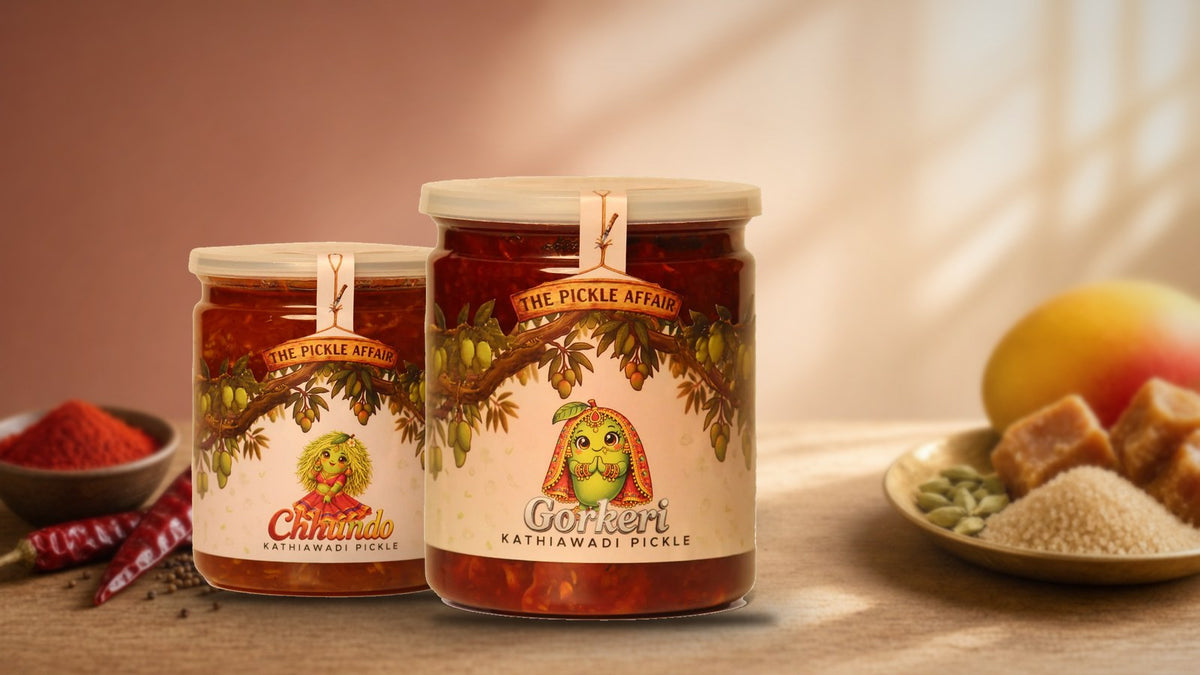
Gor Keri uses jaggery and mango pieces; Chhundo uses grated mango and sugar. How they differ in taste, texture and use.
In this guide
- Quick answer
- Two sweet pickles, two different jobs
- How Gor Keri is traditionally made
- How Chhundo is traditionally made
- Side-by-side
- What you notice in the first spoon
- How each behaves on the plate
- When to use which
- Storage differences
- Which households prefer which
- Names that cause confusion
- Choosing a good jar
- Jars to consider
- FAQs
Quick answer
Gor Keri is raw mango pieces in a jaggery-based masala — sweet, sour, and gently spiced, with chunks you can bite into. Chhundo is grated raw mango set with sugar into a smooth, jam-like relish flavoured with chilli and cumin. Choose Gor Keri for meals and Chhundo for spreading and travel.
Two sweet pickles, two different jobs
Gor Keri and Chhundo are the two best-known sweet mango pickles of Gujarat, and both start with firm raw mango. That is where the similarity ends. One is made from pieces and jaggery, the other from grated mango and sugar, and they behave very differently on the plate.
The gor keri vs chhundo question usually comes up when someone wants a sweet pickle but is not sure which to buy. The honest answer is that they are not substitutes. Gor Keri feels like a pickle that happens to be sweet; Chhundo feels like a spiced mango preserve that happens to be served as pickle.
How Gor Keri is traditionally made
Traditional Gor Keri begins with firm, sour raw mangoes such as Rajapuri, cut into pieces, then rubbed with salt and turmeric and left to release some of their water. The pieces are drained and dried before being mixed with grated jaggery and a methia-style masala of split mustard, split fenugreek, red chilli, and hing.
The mixture is kept covered and stirred every day while the jaggery slowly melts into a thick, dark syrup that coats the mango. Many homes finish it with a little oil. The mango pieces stay distinct, so every spoon has something to bite into.
How Chhundo is traditionally made
Chhundo starts with grated raw mango instead of pieces. The shreds are mixed with salt and turmeric, then with sugar. In the classic sun-cooked method, the vessel is covered with thin muslin and set in the sun for several days, stirred daily until the sugar syrup thickens to a glossy, set consistency.
Many families now make a stove-cooked Chhundo, simmering the grated mango and sugar until the syrup reaches the right thread consistency. Either way, red chilli powder and roasted cumin go in at the end. The result is spreadable, with little or no free oil.
Side-by-side
- Sweetener — Gor Keri: jaggery. Chhundo: sugar.
- Mango cut — Gor Keri: pieces. Chhundo: grated shreds.
- Texture — Gor Keri: chunks in thick syrup. Chhundo: smooth, jam-like and spreadable.
- Colour — Gor Keri: deep brown-red. Chhundo: golden amber.
- Spices — Gor Keri: mustard, fenugreek, chilli. Chhundo: mainly chilli and cumin.
- Best with — Gor Keri: rotli, thali, khichdi. Chhundo: thepla, khakhra, puri, travel.
What you notice in the first spoon
Gor Keri tastes rounder and darker. Jaggery brings caramel and slightly mineral notes, and the fenugreek and mustard give it a savoury backbone, so the sweetness never feels like dessert. The mango pieces release a sharp sourness when you bite them.
Chhundo tastes brighter and cleaner. Sugar lets the fresh mango flavour come through, and the cumin adds a warm, toasty finish. The chilli is noticeable but gentle, and because the mango is grated, sweetness, sourness, and spice arrive together in every bite rather than in waves.
How each behaves on the plate
Texture decides most of the practical differences. Gor Keri pieces sit on the side of a thali and are taken a little at a time with rotli or rice. The syrup can be spooned over khichdi or mixed into curd, but it does not spread evenly.
Chhundo spreads like jam. That makes it ideal for thepla, khakhra, and puri, where you want an even layer, and it is easy for children to eat on its own with a flatbread. It also works as a dip for dhokla or khaman when you want something sweet beside green chutney.
When to use which
- Everyday rotli-shaak-dal meal — Gor Keri.
- Thepla or khakhra for breakfast or tea time — Chhundo.
- Long train journey or travel snack box — Chhundo, because it has little free oil.
- Winter plate with bajra rotla and butter — Gor Keri.
- Festive puri and shrikhand meal — Chhundo for its even, glossy sweetness.
- Plain khichdi for someone who wants sweet with their meal — either works; Gor Keri adds more spice.
Storage differences
Both are sweet pickles, so the same basics apply: a clean, dry spoon, a tightly closed lid, and a cool, dry cupboard away from heat. Wipe the rim after every use, because sugar and jaggery attract ants faster than oil-based pickles do.
Each one changes a little in the jar. Gor Keri syrup can crystallise in cold weather, and Chhundo can thicken or develop a sugary crust on top. Neither is spoilage; stir with a dry spoon and the texture usually returns. Always follow the label for storage and best-before guidance, and discard any jar showing mould, fizzing, or an off smell.
Which households prefer which
Families with young children often keep Chhundo, because its smooth texture and clear sweetness make it an easy first pickle. Households that pack thepla for school and office tend to keep it too.
People who love the flavour of gur in chai or sweets usually prefer Gor Keri. It is also the favourite of those who want a sweet pickle that still feels like achar, with chunks, mustard, and fenugreek. Many Kathiawadi homes keep both, alongside one spicy mango pickle.
Names that cause confusion
- Gol keri — another common name for Gor Keri; gol and gor both mean jaggery.
- Chunda — the Hindi spelling of Chhundo, often seen on labels and recipes outside Gujarat.
- Murabbo — mango cooked in sugar syrup, usually in pieces and without the pickle spices.
- Methambo — a quick cooked raw mango dish with jaggery, made to be eaten within days rather than stored.
Choosing a good jar
For Gor Keri, look for distinct mango pieces coated in a thick, glossy syrup, with no sign of mould or separation into watery liquid. The colour should come from jaggery and chilli rather than bright artificial red.
For Chhundo, look for clearly visible mango shreds in a set, amber syrup, not a uniform jelly. Our Gor Keri and Chhundo are both made in small batches using traditional Kathiawadi recipes, with no synthetic colours. If you are unsure which your family will prefer, try one jar of each and see which empties first.
Shop related collections
These collection hubs match this guide’s intent — use them to compare jars before you buy:
- Explore /collections/gor-keri-jaggery-pickles
- Explore /collections/chhundo-pickles
- Explore /collections/sweet-gujarati-pickles
Jars to consider from this guide

Gor Keri | Jaggery Mango Achar
Handmade Kathiawadi pickle — ships across India.
View Gor Keri | Jaggery Mango Achar →
Chhundo | Sweet Shredded Mango Achar
Handmade Kathiawadi pickle — ships across India.
View Chhundo | Sweet Shredded Mango Achar →Frequently asked questions
Is Gor Keri the same as Chhundo?
No. Gor Keri is mango pieces in a jaggery-based masala; Chhundo is grated mango set with sugar into a smooth relish.
Which is sweeter, Gor Keri or Chhundo?
Chhundo usually tastes sweeter and smoother. Gor Keri has a deeper jaggery sweetness balanced by more spice and sourness.
Which is better for travel?
Chhundo, because it has little free oil and spreads easily on thepla or khakhra. Pack it in a tightly closed container.
Is Chhundo made with jaggery?
Traditional Chhundo is made with sugar. Some home recipes use jaggery, but the classic version is sugar-based. Check the label for the exact ingredients.
Which goes better with rotli?
Gor Keri is the classic partner for hot rotli and ghee. Chhundo also works, but it is more often eaten with thepla and khakhra.
Why has my Chhundo become thick or grainy?
Sugar syrup can thicken or crystallise over time or in cool weather. Stir with a dry spoon; it is not a sign of spoilage.
Can I serve Gor Keri and Chhundo together?
Yes, though most people pair one sweet pickle with one spicy pickle. Serving both is common on festive thalis.
Does The Pickle Affair use synthetic colours?
No. Colour comes from the spices, turmeric, chilli, and mango themselves.
Who makes The Pickle Affair pickles?
The Pickle Affair is a brand of Arham Foods, packed in Maharashtra under FSSAI licence 21521053000490.
Conclusion
In the gor keri vs chhundo choice, think about how you will eat it: Gor Keri for meals with rotli and thali, Chhundo for spreading on thepla, khakhra, and travel food. If you love sweet pickles, keeping both is the easiest way to cover every plate.


Leave a comment
Your email address will not be published. Required fields are marked *