


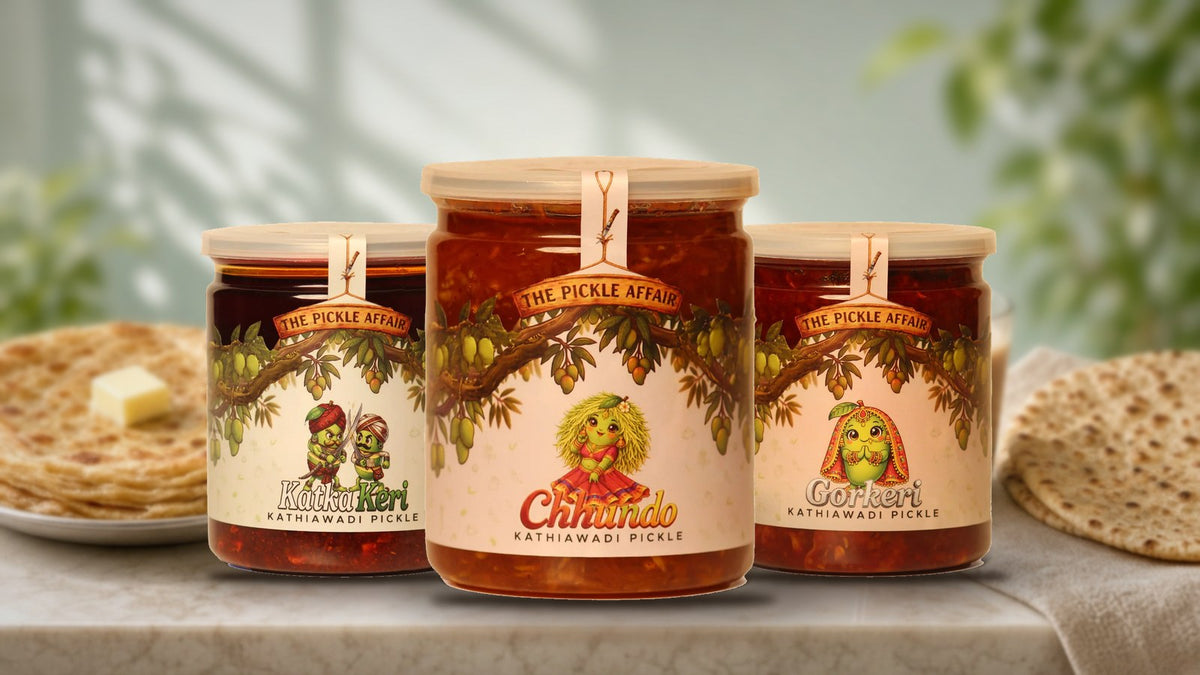
Why a Gujarati thali carries a sweet and a spicy pickle, which achar goes with which dish, and how to set up a thali pickle corner at home.
In this guide
- Quick answer
- How a Gujarati thali is laid out
- Why a thali usually has two pickles
- Which pickle goes with which part of the meal
- Gujarati thali vs Kathiawadi thali
- The traditional portion
- Sweet pickles on a Gujarati thali
- Spicy pickles on a Gujarati thali
- Setting up a thali pickle tray at home
- Common thali pickle mistakes
- Pickles for festive and wedding thalis
- Explaining the thali pickles to guests
- Jars to consider
- FAQs
Quick answer
A Gujarati thali usually carries one or two pickles at the edge of the plate: a sweet one such as Chhundo or Gor Keri and a sharp one such as Katka Keri or a spicy keri achar. The sweet pickle balances spicy shaak and farsan, while the spicy pickle adds bite to dal, rice and kadhi. A teaspoon of each is the traditional portion.
How a Gujarati thali is laid out
A full Gujarati thali is a round steel plate surrounded by small katoris. The centre holds rotli first and rice later in the meal. The katoris carry dal or kadhi, two or three shaak (vegetable dishes), a farsan such as dhokla or khandvi, a sweet like shrikhand or mohanthal, and sometimes a kathol, a curry of sprouted or dried beans.
The edge of the plate is where the accompaniments go: a spoon of athanu (pickle), a little kachumber or salad, a roasted or fried papad, and a glass of chaas beside the thali. In thali restaurants these are refilled constantly; at home they are set once and topped up as needed.
The Gujarati thali pickle is small in quantity but has a big job. It ties together a plate that already swings between sweet, sour, spicy and mild.
Why a thali usually has two pickles
Gujarati cooking is known for balancing sweet, sour and spicy within the same meal, and the pickles follow that logic. One pickle is usually sweet — Chhundo, Gor Keri or Meethi Keri — and one is sharp and spicy, such as Katka Keri or a classic mango achar.
The sweet pickle softens the chilli in the shaak and farsan and pairs naturally with rotli. The spicy pickle wakes up dal-bhaat and kadhi-rice towards the end of the meal. Together they let each diner adjust every bite to taste.
Some thalis add a third: a methi pickle, a gunda pickle, or a freshly made sambharo of cabbage, carrot and green chilli lightly tossed in mustard seeds.
Which pickle goes with which part of the meal
- Rotli and shaak — sweet Chhundo or Gor Keri, especially beside spicy shaak like ringan (brinjal) or tindora.
- Dal and rice — spicy Katka Keri or a classic homemade mango pickle to cut through the sweet-sour Gujarati dal.
- Kadhi and khichdi — a sharp keri achar or Chana Keri Methi for depth.
- Farsan — a little sweet pickle beside fried items; dhokla and khandvi usually come with their own chutney.
- Puri or thepla on a festive thali — Chhundo or Meethi Keri, the classic sweet partner.
Gujarati thali vs Kathiawadi thali
Not every Gujarati thali tastes the same. A thali from Ahmedabad, Vadodara or Surat tends to be gently sweet across many dishes, with jaggery in the dal and some shaak. Pickles here lean towards sweet styles, with one spicy jar for contrast.
A Kathiawadi thali from Saurashtra is bolder: bajra rotla, sev tameta, ringan no olo, lasaniya bataka, garlic chutney and thick buttermilk. The pickle here is often a fiery keri achar, Gunda Keri or a methi pickle, with Gor Keri as the sweet relief.
Knowing which style you are serving helps you choose. A sweet-leaning thali needs a sharper pickle to keep it lively; a fiery Kathiawadi plate needs at least one sweet pickle.
The traditional portion
On a thali, pickle is a condiment, never a side dish. The usual portion is about a teaspoon of each pickle, or one or two pieces of mango. That is enough to flavour many bites across the meal.
At home, place the pickle at the edge of the thali, away from the dal katori, so its oil does not run into the dal or soak the rotli.
Sweet pickles on a Gujarati thali
Chhundo is the most familiar sweet pickle on a thali. Traditionally it is grated raw mango slow-cooked or sun-cooked with sugar and spices into a thick, glossy relish. It sits neatly on the plate and pairs especially well with rotli, puri and thepla.
Gor Keri uses jaggery instead of sugar and has chunkier mango pieces with a deeper, caramel-like sweetness. It suits Kathiawadi plates and bajra rotla particularly well.
Spicy pickles on a Gujarati thali
The spicy pickle is usually raw mango in a red chilli, mustard and fenugreek masala. Katka Keri, with its small chunks of mango, is an everyday choice in many Gujarati homes because it is easy to portion and eat with rotli or rice.
Some families prefer Chana Keri Methi, with chickpeas and fenugreek alongside mango, for a more savoury, slightly bitter bite. Gunda Keri, with sticky lasoda berries, is more of a specialty and often appears on Kathiawadi or festive thalis.
Setting up a thali pickle tray at home
- Choose one sweet and one spicy pickle, and optionally a methi or gunda pickle.
- Spoon each into a small katori or steel saucer rather than bringing jars to the table.
- Use a separate dry spoon for each pickle.
- Place the tray at the centre of the table, or serve a teaspoon of each on every thali.
- Refill from the jar in the kitchen and close the jar promptly after each refill.
Common thali pickle mistakes
- Offering only sweet pickles on a sweet-leaning Gujarati thali.
- Serving only a fiery pickle when elders or children are eating.
- Placing pickle next to the dal katori, where oil can seep in.
- Serving large portions that overpower the shaak and dal.
- Passing the main jar around the table with shared spoons.
Pickles for festive and wedding thalis
For festivals, family functions and wedding lunches, the thali grows: more farsan, a richer sweet like basundi or mohanthal, puri instead of rotli, and sometimes two dals. Pickles stay small but become more varied, often three or four kinds along a long table.
A combo of sweet and spicy pickles makes it easy to set up a festive tray without stocking many separate jars. Gujarati pickle combo packs bring several styles together, so you can offer Chhundo, Gor Keri and a spicy keri achar side by side.
Explaining the thali pickles to guests
Guests from outside Gujarat sometimes ask why there is a sweet pickle on a savoury plate. A simple explanation helps: the sweet pickle goes with rotli and spicy shaak, the spicy one with dal and rice. Most people then enjoy moving between the two through the meal.
Shop related collections
These collection hubs match this guide’s intent — use them to compare jars before you buy:
Jars to consider from this guide

Chhundo | Sweet Shredded Mango Achar
Handmade Kathiawadi pickle — ships across India.
View Chhundo | Sweet Shredded Mango Achar →
Katka Keri Pickle | Homemade Gujarati Mango Achar
Handmade Kathiawadi pickle — ships across India.
View Katka Keri Pickle | Homemade Gujarati Mango Achar →
Gor Keri | Jaggery Mango Achar
Handmade Kathiawadi pickle — ships across India.
View Gor Keri | Jaggery Mango Achar →Frequently asked questions
Which pickle is served in a Gujarati thali?
Usually one sweet pickle such as Chhundo or Gor Keri and one spicy pickle such as Katka Keri or a classic mango achar. Some thalis add a methi or gunda pickle.
Why is sweet pickle served in a Gujarati thali?
Gujarati meals balance sweet, sour and spicy. Sweet pickle softens spicy shaak and farsan and pairs naturally with rotli and puri.
How much pickle goes on a thali?
About a teaspoon of each pickle, or one or two pieces of mango, is the traditional portion.
What is the difference between Gujarati and Kathiawadi thali pickles?
City-style Gujarati thalis lean towards sweet pickles with one spicy jar, while Kathiawadi thalis are spicier and often include a fiery keri achar, Gunda Keri or a methi pickle, with Gor Keri for sweetness.
Which pickle goes with dal and rice in a thali?
A spicy mango pickle like Katka Keri works best, cutting through the sweet-sour flavour of Gujarati dal.
Can I make a Gujarati thali at home with ready-made pickles?
Yes. Choose one sweet and one spicy traditional Gujarati thali pickle, serve small portions in katoris, and the classic pickle corner is covered.
Does The Pickle Affair use synthetic colours?
No. Colour comes from the spices, turmeric, chilli, and mango themselves.
Who makes The Pickle Affair pickles?
The Pickle Affair is a brand of Arham Foods, packed in Maharashtra under FSSAI licence 21521053000490.
Conclusion
A Gujarati thali pickle is a small spoon with a big job. Keep one sweet and one spicy jar ready, serve a teaspoon of each, and the plate stays balanced from the first rotli to the last bite of rice.


Leave a comment
Your email address will not be published. Required fields are marked *