


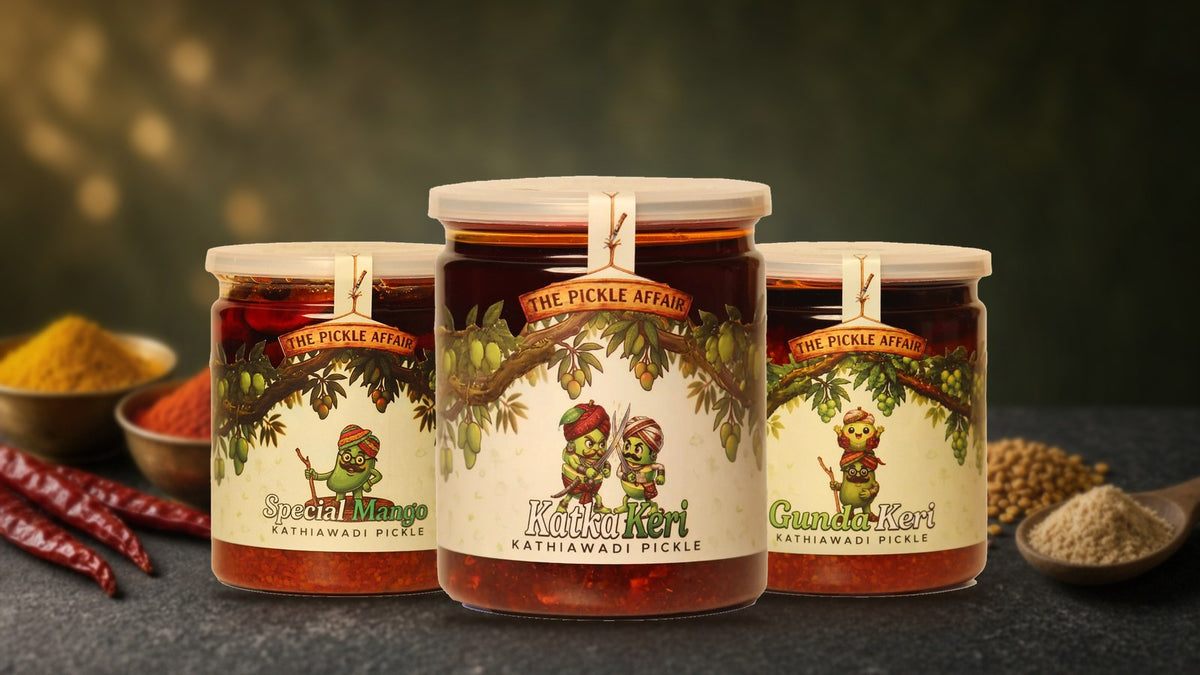
Why cooks use Kashmiri chilli in pickle for deep red colour with gentle heat, and how it compares with hotter chilli powders in Gujarati achar.
In this guide
- Quick answer
- Colour and heat are two different jobs
- Why cooks use Kashmiri chilli in pickle
- How the colour develops in oil
- Kashmiri chilli and other red chilli powders
- How Gujarati kitchens balance colour and heat
- Reading a red pickle at a glance
- Why natural colour matters
- Choosing chilli powder for a homemade pickle
- Common mistakes with chilli in achar
- Choosing a pickle by spice level
- Jars to consider
- FAQs
Quick answer
Kashmiri chilli in pickle is mainly about colour. It gives achar a deep, glossy red with mild, rounded heat, so cooks often blend it with a hotter chilli powder to set the spice level. A bright red pickle is not necessarily a very hot one; the colour and the heat usually come from different chillies.
Colour and heat are two different jobs
Every red chilli carries two things: natural red pigments that give colour, and capsaicin, the compound that makes it hot. Different chilli varieties carry very different amounts of each. Some are fiery but dull in colour; others are richly coloured but gentle on the tongue.
Kashmiri chilli sits firmly in the second group. It is prized for a deep crimson colour and a mild, slightly fruity warmth. That is why a pickle made mostly with Kashmiri chilli can look intensely red yet taste surprisingly easy to eat.
Why cooks use Kashmiri chilli in pickle
- Appetising colour — a rich red masala makes raw mango pieces look inviting in the jar.
- Controlled heat — the cook can add colour without making the pickle too fiery for children or elders.
- Rounded flavour — its mild, slightly sweet taste blends well with mustard, fenugreek, and hing.
- Flexibility — it can be paired with a hotter chilli powder to reach exactly the spice level the family likes.
How the colour develops in oil
The red pigments in chilli dissolve in fat, not water. When chilli powder meets the oil in a pickle, the colour slowly moves into the oil, which is why the oil on top of a good keri achar turns red over the first days and weeks.
This also explains why a freshly mixed pickle can look a little dull and powdery, and then becomes glossy and deep red as it matures. The masala is not changing colour on its own; the oil is carrying the colour around every piece of mango.
Light and air slowly fade chilli colour. A jar kept in a sunny spot or opened carelessly will look paler over time than one kept in a cool, dark cupboard with the lid firmly closed.
Kashmiri chilli and other red chilli powders
Indian kitchens use many chilli varieties, and each brings its own balance. Kashmiri chilli is known for colour with low heat. Byadgi chilli from Karnataka is similar: deep red, wrinkled, and fairly mild. Guntur chilli from Andhra Pradesh is famous for strong heat and is a backbone of fiery Andhra pickles.
In Gujarat, many homes use Reshampatti chilli, a local variety with good colour and a medium heat that suits everyday achar. Some families buy whole dried chillies of their preferred type and get them ground for the pickle season, often blending two kinds for the colour and bite they remember.
How Gujarati kitchens balance colour and heat
A Gujarati spicy mango pickle usually starts with a masala of split mustard seed (rai kuria), split fenugreek (methi kuria), salt, turmeric, hing, and red chilli powder, bound with oil. The chilli share is where the balance between colour and heat is decided.
A cook who wants a bright red, family-friendly Katka Keri may lean on a mild, colourful chilli. A Kathiawadi household that likes strong spice may mix in a hotter powder. Neither is the single correct way; it is a matter of the family's taste and the chillies available that season.
Sweet pickles follow the same logic. In Chhundo or Gor Keri, a little red chilli adds warmth and a pleasant blush of colour against the sugar or jaggery, and a mild chilli keeps the sweetness in front.
Reading a red pickle at a glance
- Deep red with a glossy oil layer usually means good chilli and enough oil, not necessarily high heat.
- Brownish red is common in jaggery pickles, where the gor darkens the masala.
- A pale or patchy colour can come from a milder chilli, less chilli, or a pickle kept in the light.
- An unnaturally neon red that stains everything instantly is worth questioning.
- Taste a small piece first; colour alone will not tell you how spicy a pickle is.
Why natural colour matters
Because people associate a deeper red with a better pickle, chilli powder is one of the spices sometimes adulterated with added colour. Buying chilli from a trusted source, or buying pickle from a maker who states the ingredients clearly, is the simplest protection.
The Pickle Affair does not use synthetic colours. The red in our spicy pickles comes from the chilli and spices in the masala, which is why the shade can vary slightly from one small batch to the next, depending on the season's chillies.
Choosing chilli powder for a homemade pickle
If you are making pickle at home, buy chilli powder fresh for the season rather than using a packet that has been open for months. Fresh powder smells sharp and fruity and has a lively colour; old powder smells dusty and looks dull.
Make sure the powder is completely dry. Even a little moisture in the masala can encourage mould in the finished pickle. Store it in an airtight container away from the stove, and always use a dry spoon.
For a first attempt, blend a colourful mild chilli with a smaller amount of a hotter one, and taste the masala before mixing it with the mango.
Common mistakes with chilli in achar
- Adding extra chilli late in the process, which can leave a raw, dusty taste.
- Using damp or old powder, which dulls colour and risks spoilage.
- Judging spice by colour alone and making the pickle too hot or too mild.
- Too little oil, so the colour cannot spread and the masala looks dry.
Choosing a pickle by spice level
If you prefer colour without much fire, look for sweet-spicy styles such as Chhundo or Gor Keri, where chilli is present but softened. For a balanced everyday heat, a traditional mango pickle like our Homemade Mango Pickle or Katka Keri is a good middle ground.
If you enjoy a bolder, more rustic bite, Kathiawadi styles such as Gunda Keri bring spice alongside a chewy texture. Start with a small spoon beside a plain rotli or dal-bhaat, and you will quickly learn where your family's comfort level sits.
Shop related collections
These collection hubs match this guide’s intent — use them to compare jars before you buy:
Jars to consider from this guide

Katka Keri Pickle | Homemade Gujarati Mango Achar
Handmade Kathiawadi pickle — ships across India.
View Katka Keri Pickle | Homemade Gujarati Mango Achar →
Homemade Mango Pickle | Aam ka Achar
Handmade Kathiawadi pickle — ships across India.
View Homemade Mango Pickle | Aam ka Achar →
Gunda Keri | Lasode ka Achar
Handmade Kathiawadi pickle — ships across India.
View Gunda Keri | Lasode ka Achar →Frequently asked questions
Is Kashmiri chilli used in pickle for colour or heat?
Mostly for colour. Kashmiri chilli gives a deep red with mild heat, so it is often blended with a hotter chilli when more spice is wanted.
Does a redder pickle mean it is spicier?
Not necessarily. Colour and heat come from different compounds, and a mild, colourful chilli can make a very red but gentle pickle.
Why does the oil in my pickle turn red?
Chilli's red pigments dissolve in oil. As the pickle matures, the oil carries the colour, which is a normal and welcome sign.
Can I use only Kashmiri chilli in mango pickle?
You can. The pickle will be bright and mild. If your family likes more heat, mix in some hotter chilli powder.
Why has my pickle's red colour faded?
Light, air, and time slowly fade chilli colour. Keep the jar in a cool, dark cupboard with the lid closed.
Which chilli is common in Gujarati pickles?
Many Gujarati homes use Reshampatti chilli for medium heat and good colour, sometimes blended with a milder, more colourful chilli.
Does The Pickle Affair add colour to its pickles?
No. We do not use synthetic colours; the red comes from chilli and spices, so the shade can vary slightly between batches.
Does The Pickle Affair use synthetic colours?
No. Colour comes from the spices, turmeric, chilli, and mango themselves.
Who makes The Pickle Affair pickles?
The Pickle Affair is a brand of Arham Foods, packed in Maharashtra under FSSAI licence 21521053000490.
Conclusion
Kashmiri chilli in pickle is about colour more than fire, and the best achar balances both. Judge a pickle by tasting a small piece, not by how red it looks, and keep the jar out of the light so the colour stays deep.


Leave a comment
Your email address will not be published. Required fields are marked *